Blackjack: the basic rules in five minutes
Blackjack is one of the easiest card games to learn: the goal is to get as close as possible to 21 without going over and to beat the dealer. The basic rules can be learned in a few minutes.
Updated:
Card values
Cards from 2 to 10 are worth their number, jacks, queens and kings are worth 10. The ace is worth 1 or 11, whichever suits the holder. A hand with an ace counted as 11 is called "soft".
How a hand unfolds
You place a bet, then the player and the dealer receive two cards (one of the dealer's stays face down). If the player has 21 with the first two cards, that is a blackjack, which normally pays 3 to 2. Otherwise the player chooses among:
- Hit: ask for another card.
- Stand: stop.
- Double down: double the bet and receive just one card.
- Split: with two equal cards, form two separate hands, each with its own bet.
If the total exceeds 21 the player "busts" and loses at once.
The dealer's rules
The dealer does not decide: draws up to a total of 16 and stands from 17 up. If the dealer busts, all players still in the game win. Otherwise the totals are compared: whoever is closer to 21 wins, a tie is a draw and the bet stays with the player ("push").
A few basic tips
- With 11 or less you cannot bust with one card: it is always right to hit (or double with 10 and 11).
- With 17 or more you normally stand.
- A pair of aces or eights should almost always be split; a pair of tens should never be split.
These are general guidelines, and blackjack remains a game in which the dealer has a small long-term edge.
Where to see it in action
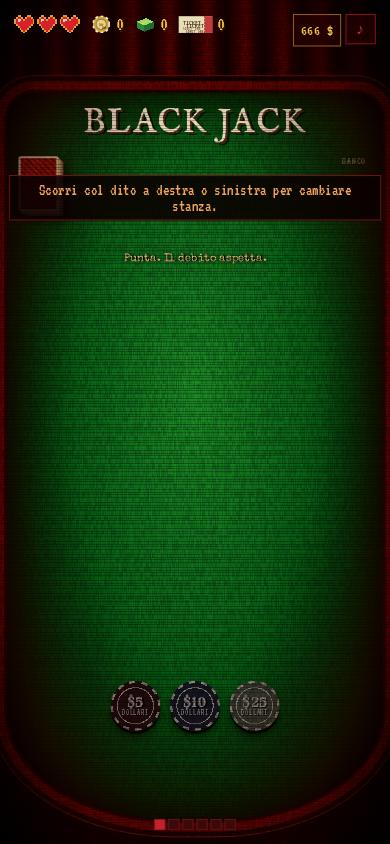
In Eternal Debt you play blackjack in a horror atmosphere with a growing debt; in Eternal Shift you are the croupier and must serve the players. In both games the money is virtual.